
Introduction
Strength training is one of the most powerful tools for improving health, function, and long-term resilience. Yet it’s often seen as expensive, time-consuming, or equipment-dependent. These barriers can feel insurmountable for busy professionals with limited time and space.
This blog post shows how you can build real, functional strength using only everyday household items; right in your living room, office, or even a hotel room. You’ll discover how to create efficient, high-intensity workouts that last just 10–15 minutes and require no specialized gear. We’ll guide you through the science of minimalist training, recommend safe and effective household substitutes for gym equipment, and provide you with a sample routine to help you get started immediately.
Whether you’re new to strength training or returning after a break, this guide will help you train smart, stay safe, and get stronger, without spending a cent.
The Case for Minimalist Strength Training
Strength doesn’t come from the gym. It comes from how you train. With the right approach, you can build muscle, improve joint stability, and boost physical performance using nothing but your own body and a few common household items. The key is to shift your focus from training as the activity itself, to the purpose or required endresult of a training session [1].
At the core of effective minimalist training are three principles: training with high intensity, using slow controlled movement, and focus on efficient movement patterns. These techniques allow you to reach muscular fatigue safely and efficiently—without necessarily heavy weights, complicated machines, or long hours. When applied correctly, they form a powerful protocol that delivers maximum results in minimal time. That type of training is called correct Exercise [2].
Train Less, Gain More with High-Intensity Efficiency
Unlike traditional routines that demand hours each week, high-intensity strength training (HIT) relies on brief, focused sessions performed only 1–2 times weekly. The goal is to bring muscles to momentary fatigue in a safe, controlled way, which triggers the body’s natural growth response without the wear and tear of excessive volume. The HIT method is one of the core tenets of correct Exercise [3].
Slow Down to Build Strength and Safety
One of the key principles behind effective (minimalist) training is time under tension: the duration your muscles are actively working during a set. By slowing down each repetition, especially during the lowering (eccentric) phase, you engage more muscle fibers and eliminate momentum, which reduces the risk of injury and boosts exercise effectiveness [4], [5].
Limit your range of motion for improved efficiency and safety
Most injuries don’t happen when muscles are working hard in stable positions. They occur when muscles are loaded in their extreme ranges of motion. These are the moments when your body is most vulnerable: the joints are less stable, muscles have poorer leverage, and passive structures like ligaments and tendons are forced to take on stress they’re not meant to handle. For example, swinging a dumbbell too far behind the body or overextending a knee can expose connective tissues to dangerous shear forces. Even body-weight training can become risky when performed with poor control at extreme ranges of motion.
That’s why training within your safe, natural range is key, not only when you’re returning from injury or managing joint pain, but also if you’re totally healthy and pain free. Staying in a controlled, mid-range position:
- Keeps joints aligned and reduces risk of soft tissue strain,
- Focuses the load directly on the working muscles, not the passive structures,
- And allows for safer intensity, especially under fatigue.
From a physiological standpoint, muscles also produce the most force at mid-range lengths, according to the strength–length curve. This is where actin and myosin filaments inside the muscle fibers have the most optimal overlap—meaning greater force production and better mechanical efficiency.
For home and minimalist training, limiting your range of motion isn’t just a safety tactic, it’s a performance enhancer. Which brings us to a powerful method that eliminates risky movement altogether i.e static contractions.
Leverage Bodyweight Exercises for Maximum Versatility
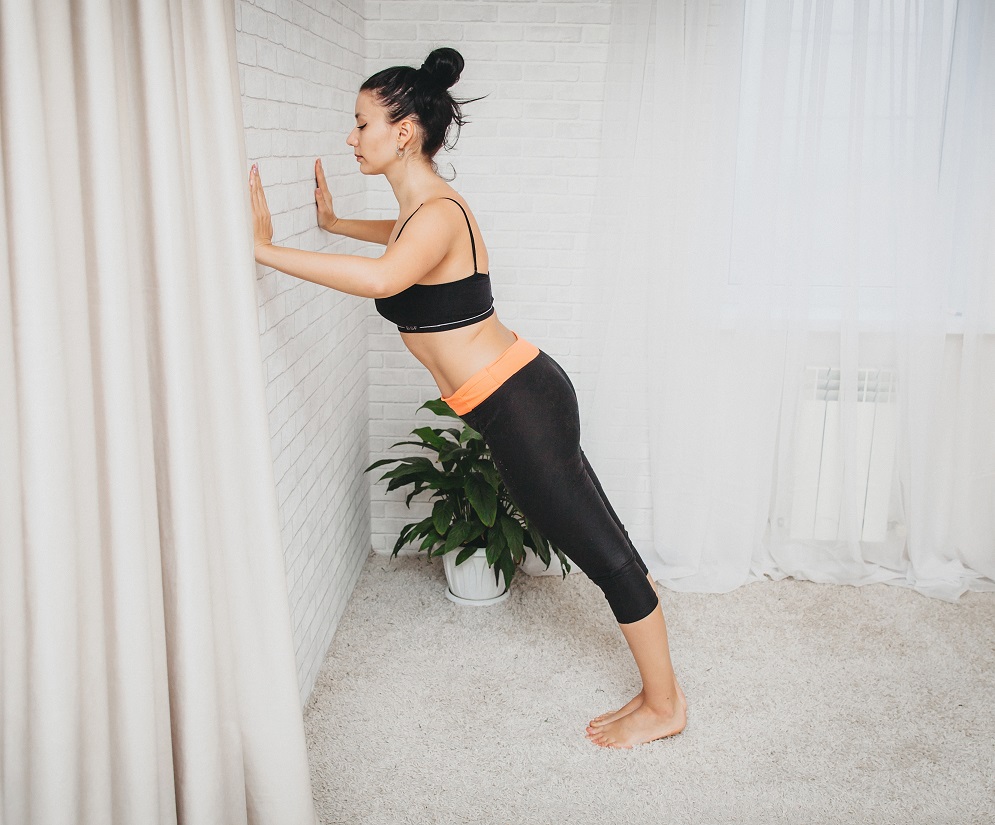
Body weight training allows for dynamic and static exercises that engage multiple muscle groups while challenging balance and stability. Movements can be scaled in difficulty by adjusting leverage, range of motion, or tempo. With bodyweight exercises only, you can fatigue most of the leg and torso musculature by performing various squatting and lunging exercises, push-up variations, and leg raising exercises from the floor. The challenge lies with exercising the muscles of the back. If you have access to a pull-up bar, you can continue using dynamic exercises for most of your workout routine. If not, you will need to incorporate static exercises using tools such as a towel or a strap.
Body weight exercises can also be a foundation for mastering proper form before adding resistance with towels, straps, or loaded backpacks. They are essential for learning movement control, improving joint stability, and developing the mind-muscle connection crucial for strength training success. Knowing how to squat deeply and bending over into a stiff-legged deadlift is of great benefit for overall mobility and flexibility.
Embrace Static Contractions for Maximum Intensity
Static, or isometric, training involves exerting force without joint movement. You might push against a wall, pull against a towel wrapped around an immovable anchor, or brace yourself against gravity in a fixed position. Despite the lack of visible motion, this method allows for maximum muscular recruitment while keeping the joints in a stable, low-risk position.
Because there’s no need to move through space or handle external weights, static contractions are especially useful in small spaces or when training with improvised tools. They’re also highly joint-friendly—ideal for anyone with mobility limitations, injury history, or general joint sensitivity. Yet this method isn’t just about convenience or safety; it’s also about scalability. The resistance is essentially limitless, dictated only by how much effort you put in.
With simple tools like a towel or strap, you can even transform traditional body-weight movements into very hugely effective and intense muscle fatiguing protocol . For example, anchoring a towel beneath your feet and pulling upward during a squat, or pushing outward during a push-up hold, allows you to accumulate a very high amount of fatigue in the strongest range of motion. This is far more efficient and intense compared to regular body-weight exercise, where the intensity fluctuates throughout the movement. That means you’re no longer restricted by gravity or body mass. You’re in control of the intensity.
This makes static contractions one of the most effective and adaptable strength training tools available, especially in minimalist environments where space, time, or equipment is limited.
Top Household Items You Can Use for Strength Training
You don’t need dumbbells or resistance bands to challenge your muscles. Many everyday objects around your home or office can be used as effective training tools, if you know how to use them with intent and control. The key is choosing items that allow you to apply force safely, maintain proper form, and simulate resistance or leverage for dynamic and static exercises.
Use Towels for Isometric Holds and Assisted Movement
A towel is one of the most versatile tools in home-based strength training. It can be used to create static resistance in many isolation as well as compound movements [6], [7]. You can perform various deadlift, row, and press variations, along with isolation exercises such as hip and shoulder abduction and adduction, biceps curls, triceps extensions, and finger squeezes. Beyond resistance work, a towel also serves well as a cushion or support, for example, when performing neck extension and flexion exercises on the floor.
This simplicity and adaptability make the towel an essential item in any minimalist strength training setup.
Turn a Backpack into a Loadable Weight
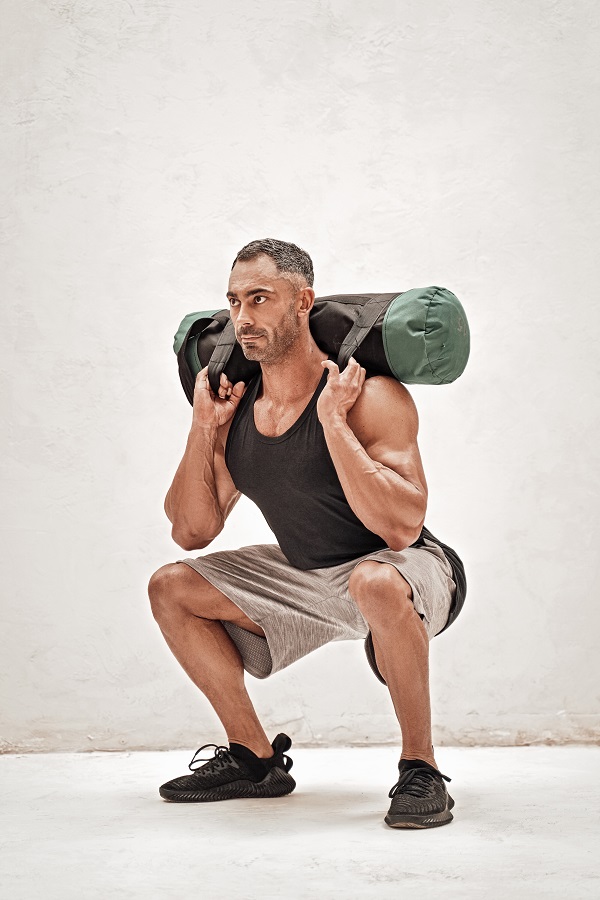
A sturdy backpack can serve as a weight vest or a substitute for a dumbbell. Fill it with books, water bottles, or some dumbbells that you have lying around to increase resistance for exercises like squats, step-ups, push-ups, or static holds. The weight is adjustable, and the straps help keep it close to your center of mass.
Leverage Chairs and Desks for Elevation and Support
Chairs, benches, or low desks can provide support for dips, incline push-ups, or Bulgarian split squats. With a chair, you can also perform static contraction-based upper body movements, such as the upright row and shrugs, by pulling on the sides of the chair while sitting on it.
Use Straps to Create Full-Body Static Contraction Routines
A sturdy yoga strap, judo belt, or towing strap is one of the most versatile and powerful tools for home-based strength training. Especially if the strap comes with loops or sewn-in handles, it opens up a wide range of exercises that can be performed safely and with high intensity.
With a strap, you can perform static contraction squats, deadlifts, rows, presses, and numerous isolation exercises targeting smaller muscle groups. The strap provides a stable connection between your body and the force you create, allowing you to generate maximum tension without needing an external anchor point.
A towing strap is a fantastic upgrade from a towel, particularly for larger trainees or those seeking a more durable option. Its greater length accommodates different body frames and exercise variations. Additionally, towing straps are built to withstand higher loads, offering both safety and longevity. The built-in loops improve grip control, reduce hand fatigue, and allow for more comfortable positioning during intense static holds or pulling exercises.
This makes the strap a premium choice for anyone committed to minimalist strength training at home or in the office.
Take Advantage of The Wall and The Floor to Provide Unlimited Resistance and Stability
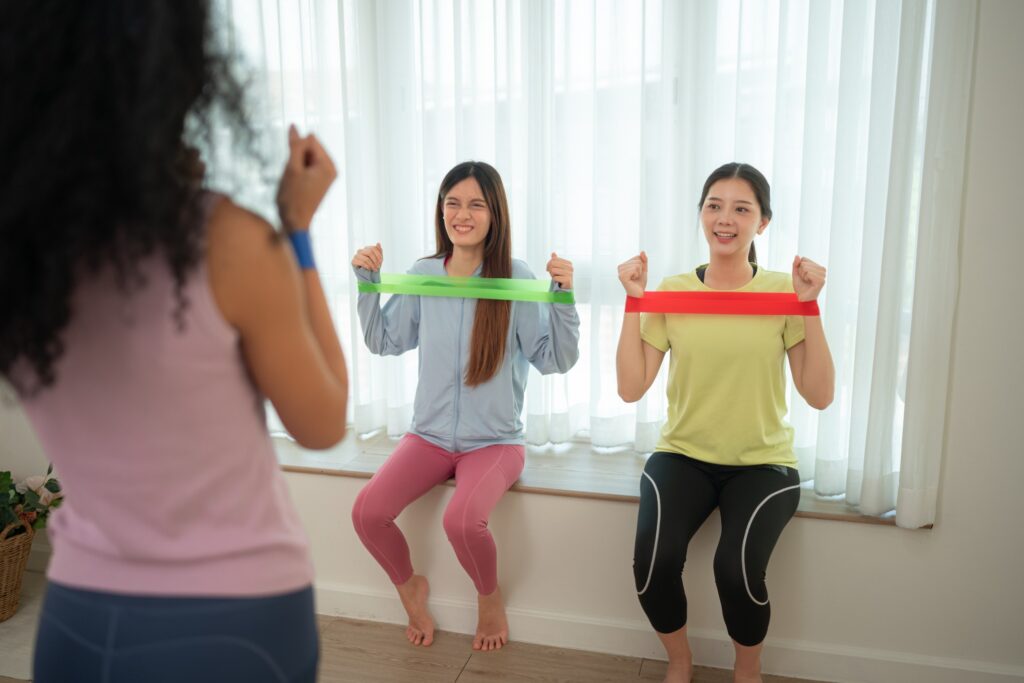
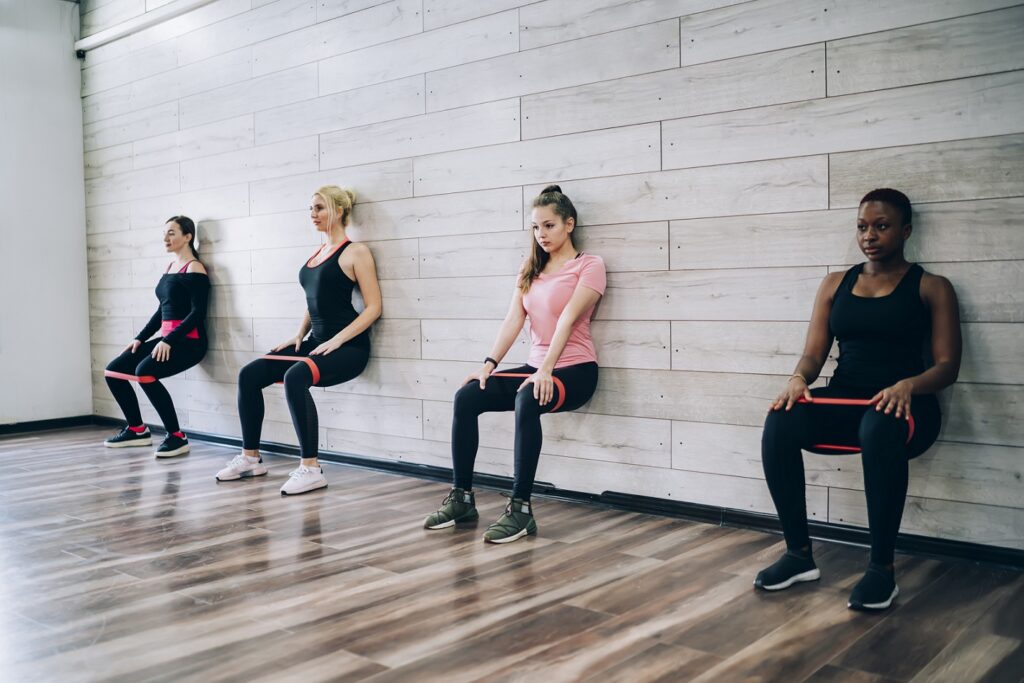
Walls are ideal for isometric holds, providing a stable and immovable surface for both static and dynamic exercises. Movements like wall sits or medicine ball dynamic squats are classics for good reason. They allow you to generate significant muscular fatigue without too much additional equipment.
While the wall is most helpful with lower body movements, you can leverage the floor for upper body exercises. You can perform neck extension and flexion while lying down. To target the upper back, push your elbows against the floor while lying on your back. For very intense lower back movements, exaggerate the low back curve while lying on your back and pull down your shoulders towards your hips. On the floor, you can also perform or simulate a unilateral hip extension or hip raises. All these movements can cause a significant level of fatigue in targeted muscle groups.
How to Structure Your Routine (in Just 10–15 Minutes)
You don’t need a long list of exercises or complicated programming to get stronger. All you need is intensity, focus, and structure. In a minimalist setup, success comes from making every second count. Your entire routine can be built around just a few movements done slowly, deliberately, and with full effort. With this method, warm-up and cool-down become integrated into the set itself. The result: a powerful full-body session in under 15 minutes.
Focus on Big Movements That Engage Major Muscle Groups
Your routine should focus on 4–6 compound exercises that simultaneously activate multiple muscle groups. These big movements deliver the greatest return for your effort and should form the core of every minimalist strength training plan.
Aim to combine lower body, upper body, and core-focused exercises to ensure balanced development and efficiency. Dynamic and static movements can be mixed and matched depending on your training preference and goals.
Dynamic movement examples:
- Super Slow Body-weight squats to target the entire lower body
- Incline push-ups on a desk to challenge the chest, shoulders, and arms
- Bent-over towel rows to build upper back and grip strength
- Leg raises on the floor for core and hip flexor engagement
- Lunges to challenge balance, coordination, and unilateral strength
Static contraction examples:
- Towel chest press (pulling hands outward with resistance) for chest and arm engagement
- Strap deadlift (standing on a strap and pulling upward) for the posterior chain
- Seated towel row for back and arm isolation
- Hip adduction and abduction using a towel or strap for improved stability around of the hips
- L-sit with heels touching the floor to develop core strength and stability
These exercises allow for endless combinations while requiring very little space or equipment. Prioritize movements that challenge the largest muscle groups and practice them consistently to develop mastery
Use a Slow Tempo for Deeper Muscle Fatigue
If you’re doing dynamic movements, slow each rep down to 5-10 seconds up (concentric) and 5-10 seconds down (eccentric). This extended time under tension increases fiber recruitment and eliminates momentum. Even 2–4 reps at this pace can bring your muscles to deep fatigue.Once you can do a dynamic exercise for more than 120 seconds, you should increase the difficulty. In principle only one set is required for each exercise. However, in order to learn the correct form of the movements, you can do multiple sets initially.
Apply the Timed Static Contraction Protocol
For static holds, use the 3-stage format:
- First 30 seconds: Light to moderate effort
- Next 30 seconds: Strong, focused contraction
- Final 30 seconds: Maximum safe effort
This protocol is also called Timed Static Contraction – TSC, Here you need to gauge your effort level applied to the immovable object subjectively. Initially, you will struggle to judge your subjective level of effort correctly. For that reason, you should perform the workout a bit more frequently and do multiple sets in order to learn the technique. Later on, only one TSC set is required for each exercise.
Train Less Often, But Train With Precision
The primary stimulus for muscle growth and strength development comes from reaching a high level of muscular fatigue. And one of the best markers of deep fatigue is the point of momentary muscular failure. This is a state, where even with your greatest effort, you are not able to overcome the given resistance (in a safe and controlled manner). Ideally, you reach the point of momentary muscular failure within a relatively short time frame; 45 to 120 seconds per exercise, to also benefit from other positive side effects of constant tension and increased blood flow to the target muscular area.
Once the body has received an effective exercise stimulus, i.e. the muscles have been sufficiently fatigued and challenged, recovery becomes the priority. Adaptation happens between workouts, not during them. For beginners, however, the ability to stimulate the body deeply is still developing. Their neuromuscular system is learning the correct movement patterns and how to contract muscles effectively. This is why beginners can often tolerate and benefit from a higher training frequency.
The goal is to reach this point of muscular failure efficiently, with minimal wear and tear on the joints and without wasting unnecessary time. Training longer does not mean better results. In fact, the longer a session lasts, the more cumulative stress and mechanical wear it places on the body.
That’s why frequency decreases as performance improves:
- Beginners: Start with 2–3 sessions per week. At this stage, trainees often lack the skill and neuromuscular efficiency to contract their muscles with maximum intensity. Performing extra volume can therefore be beneficial to learn the movement patterns, develop control, and practice the ability to contract muscles effectively.
- Intermediate/advanced: As your ability to generate deep muscular fatigue improves and you develop more precise control, reduce frequency to 1–2 sessions per week. High-effort work demands longer recovery times because the muscular and nervous system are pushed to their limits.
It is important to remember that recovery is not a passive break from training. It is where the adaptation happens. Prioritize intensity over volume, efficiency of exercise over variety, and recovery over exhaustion. This is how you build lasting strength efficiently in a minimalist setup.
Best Practices for Form and Injury Prevention
Minimalist training is only effective when it’s also safe. Using household items instead of gym equipment introduces new variables: uneven loads, less predictable grips, and non-standard supports. That’s why form, awareness, and control are essential. The following strategies will help ensure your sessions will improve your strength and prevent injuries during the workout.
Understand and Respect the Load
Not all resistance is created equal. When using improvised tools like backpacks, chairs, or books, take the time to assess:
- Is the object stable?
- Will it move under pressure?
- Is the weight evenly distributed?
A backpack filled with books can be a smart substitute for a kettlebell, unless the zipper fails or the straps break under load. Always test before applying full effort. Treat each object with the same seriousness you would a loaded barbell.
Keep Posture and Alignment Tight
Joint safety starts with alignment. When performing any movement, static or dynamic, your spine should remain neutral, with no rounding or excessive arching. Keep shoulders pulled gently down and back (not shrugged), and avoid locking elbows or knees. Think of your body as a column of stacked joints. From head to toe, everything should be in alignment to absorb force safely and efficiently.
Slow Down to Stay in Control
Momentum is the enemy of control. In dynamic movements, use a deliberate 5–10 second count for both the lifting and lowering phases. This keeps muscles under tension longer and reduces the chance of sloppy execution. For static exercises, ramp up gradually: apply light effort during the first 30 seconds, increase to moderate, and only push to maximum force in the final phase. This progressive approach protects your joints and tendons while allowing your nervous system to fully engage.
Grip Securely Without Strain
Whether you’re pulling on a strap, holding a water bottle, or pressing into a towel, grip is your connection to the resistance. Ensure that:
- Your fingers fully wrap around the object
- Wrists stay neutral. Avoid bending or overextending
- Pressure is evenly distributed to avoid pressure points.
- Avoid using sharp-edged or overly thin objects, as they can cut into your skin or cause numbness during holds.
Apply Static Force With Purpose and Caution
In earlier sections, we introduced static contractions as a highly effective and safe training method. While the absence of movement significantly reduces the risk of injury from poor form or uncontrolled motion, static exercises still require thoughtful execution. Certain habits and tendencies can compromise both performance and safety, even in a stationary hold.
To start, always select joint angles that feel naturally strong and supported, typically within the mid-range of motion. Avoid locking out joints under full effort, as this can place excessive strain on connective tissues without contributing meaningfully to the training effect. As you prepare for the contraction, build effort gradually rather than applying maximum force immediately.
Equally important is your breathing. Begin with a calm inhale before initiating the contraction, then maintain steady, continuous breathing throughout. Holding your breath, especially during longer holds of 30 seconds or more, can cause sharp spikes in blood pressure and lead to dizziness or discomfort. But even during shorter contraction periods, such as 5 to 10 seconds, conscious breathing should be maintained for safety and performance.
Listen to the Signals That Matter
Fatigue is expected. Burning in the muscle is normal. But sharp pain, numbness, or tingling are signals to stop immediately. Training should challenge your muscles, not compromise your joints or nervous system. If anything feels unstable or “off,” end the set, assess, and adjust.
Smart Progression Without Buying Equipment
Progress isn’t reserved for those with access to heavier weights or newer gear. In fact, the more minimalist your setup, the more creative and intelligent your progression needs to be. Below are proven ways to keep getting stronger, using only the tools and tension you already have.
Increase Time Under Tension
Progressive overload doesn’t require weight plates. It can come from time. By increasing how long your muscles remain under strain, you deepen the training stimulus.
For static exercises, this means:
- Reaching maximum effort earlier within your 90-second hold
- Extending the maximum-effort phase gradually
- Adding a second round of the same movement after rest
For dynamic exercises, slow your tempo to 10 seconds up, 10 seconds down. Even two reps at that pace can be enough to cause real muscular fatigue.
Adjust Leverage and Body Position
Changing your body’s position can make any movement significantly harder:
- Move further from the wall during push holds
- Use one arm or one leg instead of both
- Shift angles to challenge stability and coordination
These small changes amplify load without needing extra resistance.
Elevate the Level of Effort in Static Holds
Most trainees underperform during static exercises, not due to a lack of strength but due to a lack of effort. Over time, focus on increasing how deeply you contract during the final 30 seconds of each hold. Visualize squeezing every fiber involved. As your ability to produce maximum effort improves, so will your results.
Track Your Intensity and Perceived Effort
You can’t manage what you don’t measure. After each session, make a quick note of:
- What exercises you performed
- How hard each one felt (on a scale of 1–10)
- Whether you reached deep fatigue
- Time under constant tension or number of completed repetitions if performing dynamic exercises
Tracking this consistently builds self-awareness and shows you where you’re truly progressing.
Stay Consistent, Not Complicated
Minimalist training thrives on simplicity. You don’t need variety to make progress. All you need is consistency. Stick with the same few tools and exercises long enough to master them. Add challenge through tension, time, and effort, not novelty. The strongest bodies are built not by what they lift, but by how well they apply themselves to the lift.
Conclusions
You don’t need a gym. You don’t need fancy gear. And you don’t need weekly hours to build real, lasting strength. You need an innovative, focused approach and a willingness to apply effort with precision.
With just a few household items, like a towel, a strap, a backpack, you can build a highly effective routine that fits into your life, not vice versa. Training slowly, intentionally, and infrequently stimulates your body’s adaptive response while minimizing wear and tear. This approach doesn’t just save time, it also protects your joints, improves your posture, and builds functional strength that translates to everyday life.
The key is not what you train with, but how you train.
Stay consistent, focus on control, prioritize safety, and, most importantly, start with what you have, right where you are.
Literature
[1] S. Knez, “The Purpose Of Exercise,” BrevisFit. Accessed: Apr. 24, 2021. [Online]. Available: https://brevis-fit.com/the-purpose-of-exercise/
[2] S. Knez, “Defining Exercise: Theoretical Concepts,” BrevisFit. Accessed: Apr. 21, 2023. [Online]. Available: https://brevis-fit.com/defining-exercise-theoretical-concepts/
[3] S. Knez, “Defining Exercise: The Intensity – Safety Quadrant,” BrevisFit. Accessed: May 30, 2021. [Online]. Available: https://brevis-fit.com/the-intensity-safety-quadrant/
[4] S. Knez, “Exercise form – Guide for Safety and Efficiency,” BrevisFit. Accessed: May 09, 2022. [Online]. Available: https://brevis-fit.com/exercise-form-guide-for-safety-and-efficiency/
[5] S. Knez, “BrevisFit – Form Matters: The Science Behind Proper Exercise Form,” BrevisFit. Accessed: Jun. 13, 2024. [Online]. Available: https://brevis-fit.com/the-science-behind-proper-exercise-technique/
[6] S. Knez, “Maximize Your Workout Efficiency with Compound Exercises,” BrevisFit. Accessed: Jun. 16, 2024. [Online]. Available: https://brevis-fit.com/maximize-your-workout-efficiency-with-compound-exercises/
[7] S. Knez, “Single-joint versus multi-joint exercise – The big difference,” BrevisFit. Accessed: Apr. 01, 2022. [Online]. Available: https://brevis-fit.com/single-versus-multi-joint-exercise/
